

Published July 7, 2024 / Author: Isaiah Smith
There are a variety of reasons why you and your romantic partner may choose to start living together unmarried.
For many, a pregnancy and need for live-in childcare support may be the catalyst. Others may not be interested in the opulence and expense of a traditional marriage ceremony, or outright reject the traditional institution of marriage and believe in alternative ways of demonstrating commitment and dedication to their partner. Unmarried cohabitation may also be viewed as the starting point to build the foundation of a solid joint family venture that can support a later long-lasting marriage, or the mutual accumulation of wealth and assets in following years and decades. And of course, for some, it is simply a matter of practicality designed to split the burden of housing costs and other expenses at a time in Canadian history where rent, mortgage finance rates, and cost of living rise to unprecedented levels.
In any case, recent census data from Statistics Canada shows the typical Canadian family is diverging further from the traditional “nuclear family” structure that was at one time the norm, with more couples living in unmarried cohabitational partnerships than ever before in the nation’s history.
As the data shows, from 1981 to 2021, the number of cohabitational partnerships in Canada increased by a staggering 447%. This is much faster than the increase of the number of married couples over the same 40 year period, which rose by only 26%. Traditional married cohabitation does still remain the most common type of union between romantic partners, with more than three-quarters (77%) of cohabiting couples being married in 2021. However, the remaining 23% living in unmarried cohabitation comprise part of a group that seems positioned to only experience further growth over coming years. Indeed, this growing prevalence of unmarried cohabitation has cemented Canada as the nation with the highest proportion of cohabitational partners of all G7 nations as of 2021, including the United States (17%) and Great Britain (21%).
Suffice to say, if you are considering or currently do live with your partner unmarried- you are not alone.
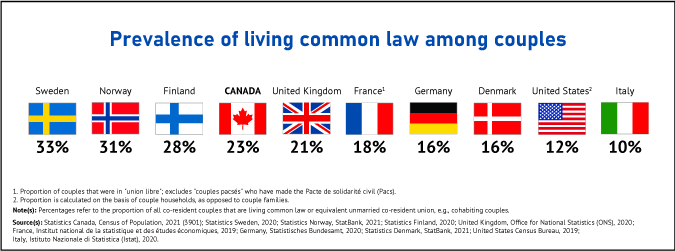
Source: Statistics Canada, 2021
Important decisions to make (and discuss)
Like in the case of traditional married cohabitation, there are many important decisions that cohabitating partners must make together to both ensure stability and peace in everyday life, and minimize risks and liabilities in the unfortunate but never impossible event that the relationship breaks down- either as a result of the unexpected and untimely death of one partner, or due to irreconcilable relationship issues. Some of these important decisions include, but are certainly not limited to:
- Whether you and your partner will make mutual efforts and work collaboratively towards common goals, like purchasing a house, or raising children;
- Whether you and your partner will integrate your finances, like opening joint bank accounts, filing taxes as a couple, or jointly own and maintain assets like a vehicle, house, or business venture;
- Whether wealth you and your partner accrue over the course of your cohabitational relationship, like chattel (personal) property, equity in a home, or profits from a business venture will be shared in life together, or distributed to the other upon one partners death; and,
- Whether you or your partner will leave the workforce, or sacrifice opportunities for career or educational advancement to raise your children, maintain the home you cohabit in, or help run a business venture
The why underlying the importance of discussing these and other important decisions with your soon to be or current cohabitational partner is multifaceted.
For one, all the above decisions mirror potential relationship problems and conflicts that could in and of themselves lead to the eventual breakdown of your cohabitational relationship. Many psychological studies focused on the most common reasons for divorce and other relationship breakdown around the world have isolated poor communication, unrealistic or imbalanced expectations, and financial conflict as major factors predicting feelings of resentment in relationships, and eventual divorce or relationship breakdown. It is in you and your partners best interest to communicate candidly, openly and honestly about these issues and set realistic and fair expectations about them together to avoid future disagreement that could weaken or destroy your relationship.
Secondly, as mentioned briefly above, even the strongest relationships can fail- and no human being is immortal. Planning for the worst case scenario of irreconcilable relationship breakdown or the unexpected death of a partner is what can help you and your family reorganize itself and pick up the pieces with grace, dignity, and relative peace of mind in the unfortunate event such does occur.
Finally, and perhaps most importantly, from a legal standpoint, Ontario family legislation like the Family Law Act generally establishes very few protections for unmarried, cohabitating partners and the property they may jointly accrue in the course of their relationship. Indeed, the property rights of married partners are fundamentally different from those of unmarried cohabitational partners.
Property rights of unmarried cohabitating partners
The most fundamental way the property rights of married partners are different than those of unmarried cohabitational partners relates to division of property and equalization.
In Ontario, the Family Law Act understands marriage to be a type of economic partnership which creates a mutual obligation for both spouses to share the value of the property they acquire during the marriage. Upon divorce (or even the death of one spouse, if elected by the surviving spouse), this obligation is enforced via an equalization payment from the wealthier spouse to the poorer, to leave each spouse with roughly half of the wealth jointly accrued during the marriage.
These legal processes do not apply to unmarried cohabitational partners however. Cohabitation alone is insufficient to create entitlement of one unmarried partner to the property of the other or its value under Ontario family legislation. Said differently, there is no mandatory division of the property of unmarried cohabitational partners, nor any right to an equalization payment for the poorer partner in the case of irreconcilable relationship breakdown or the death of one partner. This is regardless of if, for example, in reality, the unmarried cohabitating partners pooled their financial resources to purchase a home or vehicle; or if one partner left the workforce to become a homemaker, so that the other partner could maximize their working hours and income to accrue wealth or property enjoyed together or by the family. In such cases, entitlement to property or its value is determined only by title (legal ownership).
Only the common law equitable remedy of restitution for unjust enrichment may allow an unmarried cohabitational partner to assert a claim against the property of the other. This is far from a sure-shot or guarantee however, and will likely require lengthy, complex, and expensive litigation to be engaged for the mere opportunity to argue the requisite unjust enrichment of the defendant at the claimant’s expense has come to pass.
It is only a carefully drafted and properly executed cohabitation agreement that can ensure unmarried cohabitating partners have a legally enforceable procedure in place for dividing property (or its value) accrued during the course of the relationship, as per their mutual intentions.
What a cohabitation agreement can (and can’t) do
A cohabitation agreement can take many forms, and generally, should be drafted in such a way to reflect the financial intentions of both parties.
Some unmarried cohabitating partners may want to create an agreement with division of property and equalization clauses that mirror those in Ontario’s Family Law Act applicable to divorcing spouses. Others may want to identify specific property that is to be shared jointly in the event of irreconcilable relationship breakdown or the unexpected death of one partner, despite that lawful title to it is held in one partner’s name alone. And others still may want to use a cohabitation agreement to solidify each party’s intention to stay financially independent from the other, with clauses that provide each party is responsible for their own financial support and retains full unburdened title to their own lawfully titled property.
In any case, a cohabitation agreement can and should cover all significant financial decisions implicit to undertaking a serious commitment like unmarried cohabitation, including those related to the support of the other party; education or career plans and retirement; purchases and savings; rights to inherit or share property; and an acknowledgement of any dependent children.
It is important to note, however, that as per s. 53 (1)(c) of Part IV of the Family Law Act, a cohabitation agreement may not contain provisions regarding the right to decision-making responsibility or parenting time (formerly, child custody and access) related to the children of an unmarried cohabitational relationship. Here, the relevant legislative provisions of the Children’s Law Reform Act (or federal Divorce Act, in the case of a later marriage) mandatorily apply, and any such terms in a cohabitation agreement can be set aside and deemed of no force or effect by an Ontario Court. Similarly, if a cohabitation agreement specifies a child support payment obligation, such provisions may be set aside if they are found to be widely and unfairly divergent from the standards for child support set by Ontario’s Child Support Guidelines. Nonetheless, this same subsection of the Family Law Act carves out some freedom for unmarried cohabitating partners to at least determine standards around the education and moral (e.g., religious) training of their children in a cohabitation agreement.
Cohabitation agreements and spousal support
Regarding spousal support obligations, the Family Law Act creates no mandatory framework for both unmarried and cohabiting or married partners, and such obligations or rights may be included in a cohabitation agreement with much lower risk of later modification by an Ontario court. On this point though, it would be prudent to be mindful of the basic eligibility criteria to claim spousal support under sections 29 and 30 of the Family Law Act, which include:
- Cohabitation for at least three (3) years, or
- Having a child together (including through adoption), and be in a relationship of “some permanence” (determined by the relevant case law)
Once an unmarried cohabitating partner meets either of the above two thresholds, the exact amount and duration of spousal support is generally determined as per the Spousal Support Advisory Guidelines and relevant case law. Accordingly, to avoid lengthy, complex, and expensive litigation in the event of irreconcilable relationship breakdown, unmarried cohabitational partners should ensure their cohabitation agreement clearly specifies whether a certain duration of cohabitation, and/or the birth of a child creates entitlement of one party to spousal support, the amount, and duration support is to be paid. It is also possible for the cohabitation agreement to include a complete waiver of spousal support obligations for all parties to the agreement.
Cohabitation agreements become marriage contracts
One final provision of the Family Law Act to keep in mind when thinking about what the ideal cohabitation agreement might look like between you and your partner is s. 53(2), which describes the effect of a marriage on a cohabitation agreement. In short, if the parties to a cohabitation agreement marry each other, the cohabitation agreement shall be deemed to be a marriage contract.
This legislative provision has some significant implications for division of property and equalization if the parties to the agreement were to become married, but later divorce. In essence, the provisions of the cohabitation, turned marriage agreement related to division of property, support, and any other important financial decisions will supersede the relevant provisions of the Family Law Act, unless for some reason such terms are set aside, or the agreement as a whole is voided by an Ontario Court. Accordingly, a term should be included in all cohabitation agreements related to how a later marriage should affect its enforceability, either in whole or in part. For example, some unmarried, cohabitating partners may intend and include a term that the agreement should continue unmodified. Others may intend and include a term that formal engagement to be married, or the marriage itself should trigger a rescission of the agreement and a redraft negotiation period.
Drafting and executing a cohabitation agreement
As highlighted by the discussion above, making an honest, fulsome effort to consider, discuss, and reach agreement on the many financial decisions implicit to engaging in a cohabitational relationship with your partner can both help reduce the chance of a potential relationship-ending conflict arising during the relationship, as well as lessen the chance of upsetting disputes occurring in the event of a separation. As further highlighted, the law in this area is in no way straightforward. For most unmarried partners thinking about cohabiting and its financial risks, it would be prudent to retain a family lawyer to draft a cohabitation agreement to maximize the chance of it having the intended legal effect. A family lawyer can also ensure the cohabitation agreement complies with the general formal validity requirements for all domestic contracts established by Part IV of the Family Law Act, and provide independent legal advice before it is signed and executed.
If you have further questions about cohabitation agreements, or any family law issue more generally, do not hesitate to contact me.
This article contains general, publicly available legal information relevant to the jurisdiction of Ontario, Canada. Its content should not be construed as legal advice, nor relied upon as such. If you require personally tailored legal advice for a cohabitation agreement or other family law issue, please consult with a licensed lawyer practicing in your jurisdiction.
 Isaiah Smith Law